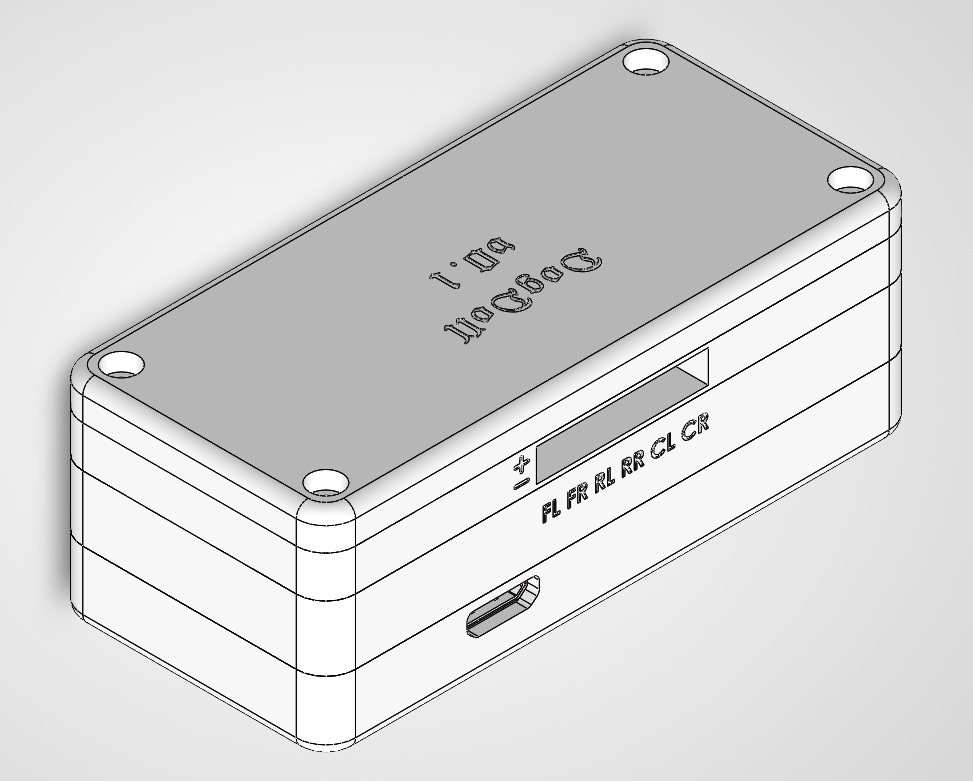
This is my biggest, most ambitious project yet. During a reunion BBQ my friend Finn from Desinity told me about a potential business venture. Through Gentrepreneur he had met Ralitsa, a veterinary medicine student who wanted to make improvements in the stethoscopy training equipment. She found the current options on the market to be vastly overpriced and lacking modern features. She had numerous ideas for features but found herself lacking the technical expertise to make it happen. I proceeded to get in touch with her, and we started pitching ideas to each other.
The current goal is to build an anatomically correct simulation doll of a dog. The doll is to contain 6 speakers which can be independently driven by an embedded computer. Using these speakers, a variety of sounds can be played back in order to recreate certain diseases in dogs. The sound system designed in a modular fashion, meaning it can easily be transfered to other animals in the future as well. We’re also looking into making add-ons like for example a physical heart beat pulse system.
Currently, the project is still very much in the prototyping stage. A first working prototype has been built, but it will still take a lot of time and resources in order to design custom hardware and get it manufactured at scale. The prototype is based around a Raspberry Pi Zero 2W, a CM106 USB sound card and 3 stereo amplifier boards. A custom 3D printed enclosure is used, and the 6 speakers are connected via header pins. From my research there was no audio backend available that could handle playback of 6 audio files indepenently, so I designed one myself.
This backend is controlled by a web UI featuring 6 fully independently controlled audio channels. The idea is to enable the user to add multiple profiles to simulate different conditions. Along with this, we want to give the user the tools to use their own audio recordings as well. We’re still exploring possibilities around creating different modes for students and professors, and adding more interactivity through an app and QR codes.
Below is a short video recorded during the testing process of one of the first prototypes.