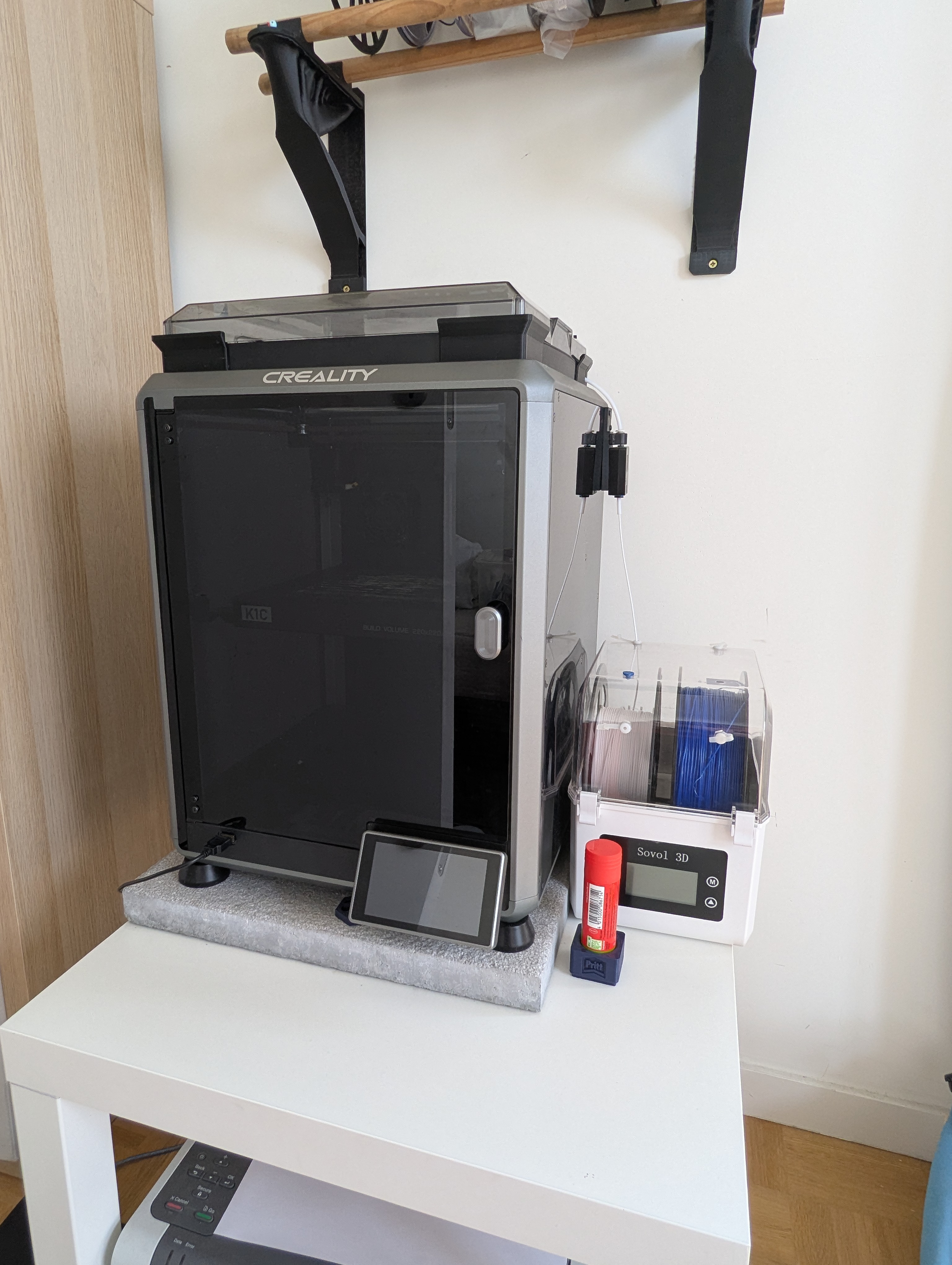
After the fiasco that was the Kingroon KP3S Pro V2 , I was looking to expand my production capabilities. I mainly wanted to add the capability of printing ABS/ASA. As these filaments are very prone to warping, it’s advised to print these in a fully enclosed printing chamber.
Fit for purpose
Enter the Creality K1C , a revision of the Creality K1 looking to compete with Bambu Lab’s X1 Carbon. This printer features:
- CoreXY motion system
- 220*220*250mm Build volume
- All metal hotend (up to 300°C)
- Hardened steel nozzle
- Fully enclosed printing chamber
The CoreXY motion system keeps the total moving mass as low as possible, making for very fast printing. The fully enclosed chamber makes the printer suitable for warp-prone filaments. Additionally, the all metal hotend combined with a hardened steel nozzle allows printing of abrasive filaments like carbon or glass fiber reinforced nylons.
This means the K1C is perfectly suited for a wide range of engineering grade filaments while still being affordable.
Issues and modifications
Creality 3D printers are famous for their accessibility and good price/performance ratio. They are however also known for not being very well polished and relying on the community to get the machines to their full potential.
JC Lid riser
By default the K1C comes with a lid to enclose the print volume. Unfortunately there’s no good way to store it anywhere. The JC-Creality K1 Hinged Lid Riser aims to fix that problem by having it hinged on top of the printer.
Cartographer bed scanner
While the K1C is great at producing dimensionally accurate parts, I kept running into issues with bed adhesion on larger prints. Large flat surfaces would often curl up around the corners and first layers were not as consistent as I would’ve liked.
By default, the K1C uses a load cell embedded in the print bed to determine Z offset. It probes a grid of points on the bed and uses those to build a bed mesh. While this works okay, precision isn’t always the best.
To improve first layer accuracy I decided to convert my K1C to a Skeletor MK7 Toolhead printed out of ABS. This is a toolhead replacement that includes mounts for the Cartographer 3D inductive bed probe . As the name implies, this is a bed probe that measures the surface of the print bed by measuring inductive Eddy currents in the metal of the bed itself. This makes for extreme accuracy, as well as very fast bed mesh generation. Instead of probing different points, the Cartographer can simply scan the entire print bed by quickly moving over it. As a bonus, the Skeletor MK7 also drops some significant weight from the toolhead.
As the standard Creality firmware doesn’t have support for the Cartographer, the printer was converted to run Simple AF Firmware .
These modifications caused a big improvement in first layer accuracy, and the printer is now more reliable than ever!